

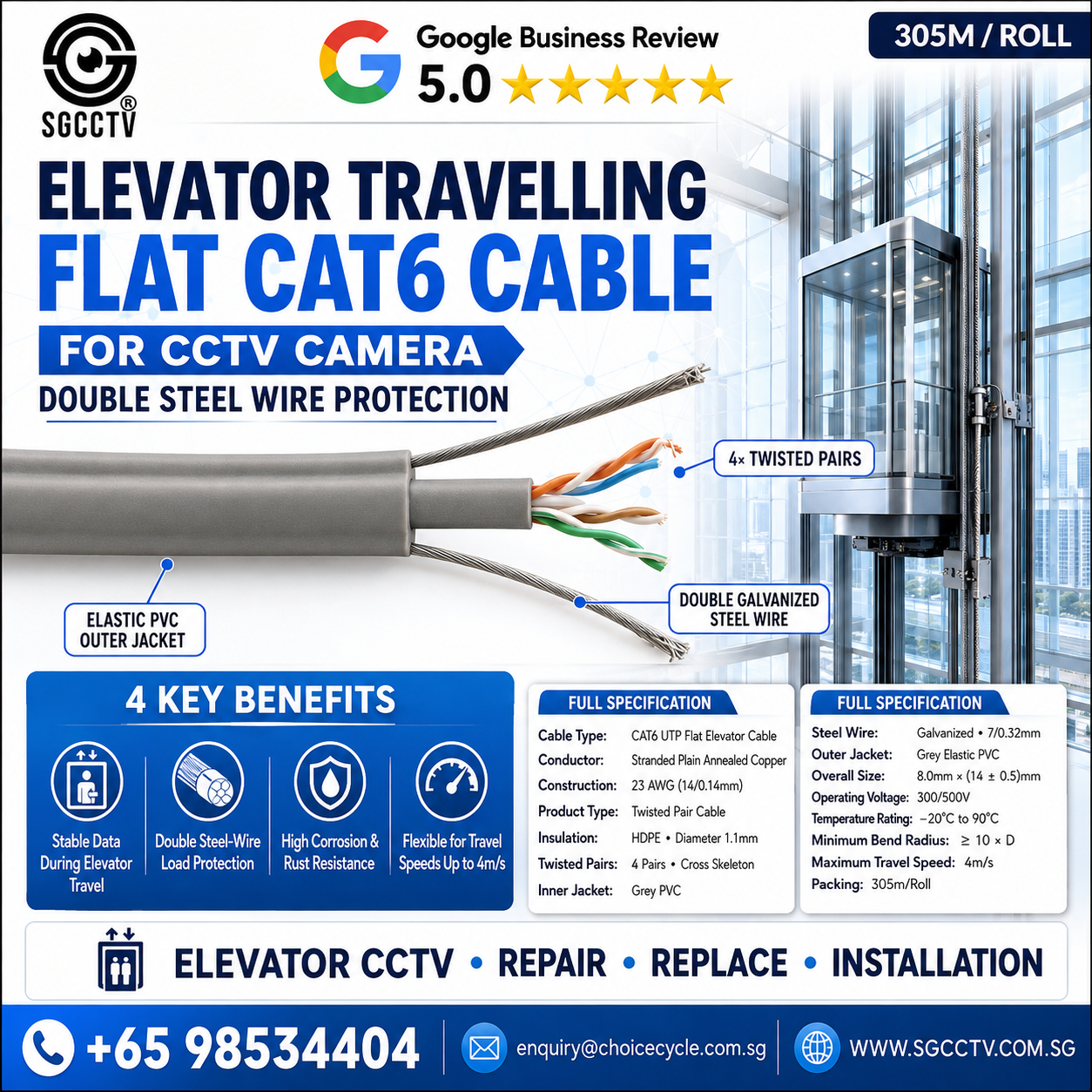


CAT6 Lift Travelling Elevator Flat Cable for CCTV Camera
 CHOICECYCLE
Address:
1 Rochor Canal Road, #02-81 Sim Lim Square 188504
Singapore.
9853 4404
 8198 5572
enquiry@choicecycle.com.sg
Frequently bought together:


CAT6 Lift Travelling Elevator Flat Cable for CCTV Camera Double Steel Wire Protection by SGCCTV Choicecycle CCTV
CAT6 Lift Travelling Elevator Flat Cable for CCTV Camera | Double Galvanized Steel Wire Protection | PoE Network Cable | SGCCTV Choicecycle CCTV Singapore
The SGCCTV / Choice CAT6 Lift Travelling Elevator Flat Cable is designed specifically for CCTV cameras, IP networks and PoE applications inside moving lift and elevator systems.
Unlike ordinary rigid CAT6 installation cable, lift travelling cable must continuously move with the elevator car. Its construction therefore combines stranded copper CAT6 conductors, flexible insulation and jacket materials, a flat travelling-cable structure and dual galvanized steel-wire reinforcement to withstand repeated movement.
It is particularly suitable for IP CCTV cameras installed inside lift cars, where both network data and PoE power must travel between the moving elevator cabin and the building's fixed CCTV infrastructure.
CAT6 Lift Travelling Elevator Flat Cable for CCTV Camera Double Steel Wire Protection by SGCCTV Choicecycle CCTV
CAT6 Lift Travelling Cable – Key Specifications
| Specification | Details |
|---|---|
| Cable Type | CAT6 UTP Flat Elevator Travelling Cable |
| Application | Lift / Elevator CCTV & Network |
| Conductor | Stranded Annealed Copper |
| Conductor Construction | 23 AWG – 14/0.14mm |
| Number of Pairs | 4 Twisted Pairs |
| Insulation | HDPE |
| Insulation Diameter | Approx. 1.1mm |
| Pair Separator | Cross Skeleton |
| Inner Jacket | PVC |
| Reinforcement | Dual Galvanized Steel Wire |
| Steel Wire Construction | 7/0.32mm |
| Outer Jacket | Elastic PVC for Elevator Cable |
| Cable Profile | Flat Travelling Cable |
| Approx. Dimension | 8.0mm × 14 ±0.5mm |
| Typical Colour | Grey |
| Rated Voltage | 300/500V |
| Bend Radius | ≥10 × Cable Diameter |
| Maximum Travel Speed | Up to 4m/s |
| Standard Length | 305m / Roll |
| Other Lengths | Subject to requirement |
CAT6 Lift Travelling Elevator Flat Cable for CCTV Camera Double Steel Wire Protection by SGCCTV Choicecycle CCTV
Why Ordinary CAT6 Cable Is Not Ideal for a Moving Lift
Standard horizontal CAT6 cable is primarily intended for stationary installation.
Once installed above a ceiling, inside trunking or in a server room, the cable normally remains in the same position for years.
A lift is completely different.
An elevator may travel:
UP
↓
DOWN
↓
UP
↓
DOWN
hundreds or thousands of times.
The network cable serving the lift car moves every time the elevator moves.
Repeated flexing can place mechanical stress on a cable that was not designed as a travelling cable.
For this reason, a dedicated:
CAT6 LIFT TRAVELLING FLAT CABLE
is a more appropriate engineering solution for CCTV installed inside a moving elevator.
Dual Galvanized Steel Wire Protection
One of the most important construction features is:
DOUBLE GALVANIZED STEEL-WIRE REINFORCEMENT
Steel reinforcement is incorporated into the travelling-cable construction to provide additional mechanical support.
The galvanized treatment also provides improved resistance to corrosion and rust compared with untreated steel.
For a moving lift application, this reinforcement is important because the cable is continuously subjected to:
Movement
Flexing
Mechanical Loading
Repeated Travel
Vertical Installation Conditions
The steel support members help the cable structure handle mechanical forces rather than placing unnecessary load solely on the CAT6 data conductors.
Stranded Copper Conductors
The CAT6 section uses:
STRANDED ANNEALED COPPER
rather than the conventional solid conductor commonly found in fixed building CAT6 cable.
The specified construction is:
23 AWG – 14/0.14mm
Multiple fine copper strands provide greater flexibility than a single solid conductor.
This is particularly important in a lift environment because the cable is designed to move.
Fixed CAT6
Solid Copper
→ Excellent for fixed horizontal cabling
Lift Travelling CAT6
Stranded Copper
→ Better suited to repeated movement
The correct cable should therefore be selected according to the mechanical application, not simply according to the CAT6 label.
4 Twisted Pairs
The network portion contains:
4 TWISTED PAIRS
as expected for Ethernet CAT6 transmission.
The twisted-pair construction supports standard network applications and can be used for compatible:
IP CCTV Cameras
PoE Cameras
Lift Communication Devices
Network Equipment
Digital Video Applications
A cross separator is incorporated to help maintain pair geometry within the cable.
CAT6 for Lift CCTV Camera
A typical elevator CCTV architecture can be:
IP CAMERA INSIDE LIFT
↓
CAT6 LIFT TRAVELLING CABLE
↓
LIFT SHAFT / MACHINE ROOM
↓
PoE NETWORK SWITCH
↓
CCTV NVR
↓
SECURITY COMMAND CENTRE
This provides a wired network connection between the moving lift cabin and the fixed CCTV network.
For suitable systems, the same CAT6 link can carry:
VIDEO DATA + PoE POWER
reducing the need for separate network and camera-power cabling.
PoE CCTV Camera Application
PoE — Power over Ethernet — allows compatible IP cameras to receive electrical power and Ethernet data through the network connection.
Conceptually:
PoE SWITCH
↓
CAT6 LIFT TRAVELLING CABLE
↓
IP CAMERA
The camera receives:
POWER + NETWORK DATA
over the Ethernet infrastructure.
However, the complete PoE design must consider cable length, conductor characteristics, connectors, power requirement and the specific PoE camera.
For demanding PoE equipment or unusually long runs, voltage drop and total link performance should be verified during system design.
Suitable for HIKVISION, DAHUA, HANWHA, UNV and Other IP CCTV
A CAT6 lift travelling cable is fundamentally part of the Ethernet infrastructure rather than a proprietary camera cable.
It can therefore be used with compatible IP surveillance systems from manufacturers such as:
HIKVISION
DAHUA
HANWHA WISENET
UNIVIEW
AXIS
VIGI
and other standards-based network-camera systems.
Compatibility ultimately depends on the network and PoE requirements of the connected equipment.
CAT6 Lift Travelling Elevator Flat Cable for CCTV Camera Double Steel Wire Protection by SGCCTV Choicecycle CCTV
HDPE Insulation
The twisted-pair conductors use:
HIGH-DENSITY POLYETHYLENE – HDPE
insulation.
Specified insulation diameter is approximately:
1.1mm
The insulated twisted pairs are arranged as a four-pair group within the travelling-cable construction.
Cross Skeleton Pair Separator
The cable incorporates a:
CROSS SKELETON
between the twisted pairs.
This helps maintain separation and geometry between the Ethernet pairs.
Maintaining pair structure is important for CAT6 data transmission because excessive pair deformation can affect electrical characteristics.
Elastic PVC Elevator Cable Jacket
The outer jacket is not simply a conventional rigid network-cable sheath.
It uses:
ELASTIC PVC SPECIAL FOR ELEVATOR CABLE
to accommodate the mechanical requirements of a travelling installation.
The cable has a flat profile of approximately:
8.0mm × 14mm
with the specified manufacturing tolerance.
The flat design helps the cable travel in a controlled manner as the elevator moves.
Why Flat Cable for Elevator Applications?
The flat geometry is intentional.
An elevator travelling cable needs predictable movement.
A properly designed flat travelling cable can provide:
Controlled Bending
Improved Cable Organisation
Reduced Twisting
Mechanical Stability
Better Travelling Behaviour
This differs fundamentally from installing a conventional round LAN cable loosely inside a moving elevator shaft.
CAT6 Lift Travelling Elevator Flat Cable for CCTV Camera Double Steel Wire Protection by SGCCTV Choicecycle CCTV
Up to 4m/s Travel Speed
The specified maximum travelling speed is:
4 METRES PER SECOND
This makes the cable suitable for many lift and elevator CCTV applications within its design parameters.
Actual suitability should always be checked against:
Elevator Speed
Travel Height
Cable Suspension Method
Bending Radius
Installation Environment
Lift Manufacturer Requirements
For lift projects, coordination with the lift contractor is essential.
Bending Radius
The specified bending radius is:
≥10 × D
Maintaining the correct bend radius is critical.
Excessively tight bending can cause:
Conductor Fatigue
Pair Deformation
Mechanical Damage
Network Performance Problems
Reduced Cable Life
Lift travelling cable should therefore be installed according to its mechanical specifications rather than treated like ordinary patch cable.
CAT6 Lift Cable vs Ordinary CAT6 Cable
| Feature | Ordinary CAT6 | CAT6 Lift Travelling Cable |
|---|---|---|
| Typical Application | Fixed LAN | Moving Elevator |
| Conductor | Often Solid | Stranded Copper |
| Continuous Movement | Not Primary Purpose | Designed for Movement |
| Cable Shape | Usually Round | Flat |
| Steel Support | Normally No | Dual Steel Reinforcement |
| Flexible Jacket | Standard | Elevator-Specific Elastic PVC |
| CCTV Application | Fixed Camera | Lift Car Camera |
| PoE | Yes, when compliant | Yes, subject to system design |
The difference is not cosmetic.
The cable construction is adapted to the mechanical requirements of the elevator environment.
CAT6 Lift Travelling Elevator Flat Cable for CCTV Camera Double Steel Wire Protection by SGCCTV Choicecycle CCTV
New Lift CCTV Installation
For a new elevator CCTV project, the complete system may include:
1 × IP Camera inside each lift
CAT6 Lift Travelling Cable
RJ45 Termination
PoE Switch
Fibre / CAT6 Backbone
NVR
Surveillance Hard Disk
Security Monitor
Remote Viewing
The lift contractor and CCTV contractor should coordinate cable routing, travelling-cable installation and interface points.
Existing Lift CCTV Upgrade
Many older elevators still use:
Analogue CCTV Camera
Coaxial Travelling Cable
When upgrading to a modern IP surveillance system, the new architecture may require an Ethernet travelling connection.
For example:
OLD SYSTEM
Analogue Camera
↓
Coaxial Cable
↓
DVR
NEW SYSTEM
4MP / 8MP IP Camera
↓
CAT6 LIFT TRAVELLING CABLE
↓
PoE Network
↓
NVR
This allows the lift CCTV system to become part of the building's modern IP surveillance infrastructure.
Lift CCTV Camera Keeps Disconnecting?
An unstable lift camera does not automatically mean the camera is faulty.
If the problem happens specifically when the elevator moves, investigate the travelling connection.
Common causes include:
Damaged Travelling Cable
Poor RJ45 Termination
Conductor Fatigue
Excessive Bend Radius
Incorrect Cable Type
Loose Connector
PoE Voltage Drop
Network Switch Problem
Cable Joint Failure
Camera Power Problem
A useful diagnostic clue is:
Camera works when lift is stationary but disconnects during movement.
That strongly suggests investigating the moving cabling and connections before replacing the IP camera.
CAT6 Lift Travelling Elevator Flat Cable for CCTV Camera Double Steel Wire Protection by SGCCTV Choicecycle CCTV
Troubleshooting Lift CCTV
A systematic troubleshooting sequence is:
IP CAMERA
↓
RJ45 CONNECTION
↓
CAT6 LIFT TRAVELLING CABLE
↓
FIXED NETWORK CABLE
↓
PoE SWITCH
↓
NVR
↓
SECURITY MONITOR
Testing should ideally be performed while the lift travels through its operating range.
A cable fault may not appear when the elevator is stationary.
Double Steel Wire for Better Mechanical Support
The dual steel-wire construction is one of the main reasons this cable is different from a standard CAT6 network cable.
It provides reinforcement on the travelling assembly and helps support the cable during repeated vertical movement.
For elevator applications, the network conductor should not be expected to act as the mechanical suspension element.
The mechanical and communications functions should be properly engineered into the travelling cable.
Applications
The CAT6 Lift Travelling Elevator Flat Cable is suitable for projects such as:
Lift CCTV Camera
Elevator IP Camera
Condominium Lift CCTV
Commercial Building Elevator
Shopping Mall Lift
Office Building Lift
Factory Goods Lift
Warehouse Elevator
Hotel Lift CCTV
Hospital Elevator CCTV
MCST CCTV Upgrade
Building Security System
PoE Camera inside Lift
Elevator Network Communication
CAT6 Lift Travelling Elevator Flat Cable for CCTV Camera Double Steel Wire Protection by SGCCTV Choicecycle CCTV
Property & Facility Management
Lift CCTV frequently involves several stakeholders:
MCST / Building Owner
Managing Agent
Facility Management
Security Contractor
Lift Contractor
Network Contractor
A successful project requires coordination between these parties.
The CCTV contractor should not interfere with lift systems without appropriate coordination and authorisation.
Similarly, the travelling cable must be correctly installed and positioned so that it does not interfere with elevator operation.
Why Choose Dedicated CAT6 Lift Travelling Cable?
The major benefits are:
1. Designed for Moving Elevators
Unlike ordinary fixed CAT6 infrastructure cable.
2. Stranded Copper Conductors
Provides flexibility for travelling applications.
3. Dual Galvanized Steel-Wire Reinforcement
Adds mechanical support and durability.
4. CAT6 UTP Network Transmission
Suitable for IP surveillance and Ethernet applications.
5. PoE Application
Can support compatible PoE IP-camera systems when correctly engineered.
6. Flexible Flat Construction
Designed for controlled elevator movement.
7. Elevator-Specific PVC Jacket
Better suited to repeated flexing than ordinary fixed network cable.
8. CCTV Upgrade Ready
Useful when migrating lift surveillance from analogue to IP CCTV.
SGCCTV Choicecycle Lift CCTV Singapore
SGCCTV – Choicecycle CCTV Pte Ltd provides security-system equipment and solutions for:
CAT6 Lift Travelling Cable
Elevator CCTV Camera
Lift IP Camera
PoE CCTV
Lift CCTV Upgrade
CAT6 Network Cabling
CCTV Camera Replacement
PoE Switch
NVR
CCTV Network Troubleshooting
Commercial Building CCTV
Condominium / MCST CCTV
Security System Installation
For lift CCTV projects, cable installation should be coordinated with the authorised lift contractor and relevant building management requirements.
Website: www.sgcctv.com.sg
Email: enquiry@choicecycle.com.sg
WhatsApp: +65 9853 4404
10 Frequently Asked Questions
1. What is CAT6 Lift Travelling Cable?
It is a flexible CAT6 network cable specifically constructed for travelling applications inside elevators, where the cable repeatedly moves with the lift car.
2. Why can't I simply use ordinary CAT6 cable inside a lift?
Conventional horizontal CAT6 cable is primarily designed for fixed installation. A lift travelling cable uses a flexible stranded construction, specialised jacket and mechanical reinforcement suited to repeated movement.
3. Can this cable be used for an IP CCTV camera?
Yes. It is designed for applications including Ethernet-connected CCTV cameras inside elevator cars.
4. Does it support PoE?
It can be used in compatible PoE CCTV applications. The complete cable length, terminations, camera power consumption and PoE design should be verified.
5. Why are there steel wires inside the travelling cable?
The galvanized steel reinforcement provides mechanical support to help the travelling assembly withstand repeated movement and vertical mechanical loads.
6. Is the conductor solid or stranded?
This travelling-cable specification uses stranded annealed copper, with a specified 23 AWG 14/0.14mm construction.
7. How many network pairs are inside the cable?
There are four twisted pairs, consistent with CAT6 Ethernet cabling.
8. What is the maximum specified travelling speed?
The specification indicates a maximum travel speed of 4m/s.
9. What cable length is available?
A standard configuration is 305 metres per roll, with other supply lengths potentially available according to project requirements.
10. Can SGCCTV troubleshoot an existing lift CCTV camera that keeps disconnecting?
Yes. Troubleshooting should cover the camera, RJ45 terminations, travelling CAT6 cable, PoE power, network switch, NVR and fixed network infrastructure.
CAT6 Lift Travelling Elevator Flat Cable for CCTV Camera Double Steel Wire Protection by SGCCTV Choicecycle CCTV
CAT6 Lift Travelling Cable Singapore, CAT6 Elevator Cable, Lift CCTV Cable, Elevator CCTV Camera Cable, CAT6 Flat Elevator Cable, Double Steel Wire CAT6 Cable, Dual Galvanized Steel Wire Cable, PoE Lift Camera Cable, Lift IP Camera Cable, Elevator Network Cable, CCTV Lift Cable Singapore, Flexible CAT6 Cable, Stranded Copper CAT6, Lift CCTV Installation Singapore, Elevator CCTV Repair, MCST Lift CCTV, Security System Singapore, SGCCTV, Choicecycle CCTV
#CAT6 #LiftCable #ElevatorCable #LiftCCTV #ElevatorCCTV #CAT6Cable #FlatCable #PoE #PoECamera #IPCCTV #CCTVCamera #ElevatorSecurity #CCTVSingapore #SGCCTV #Choicecycle
Choicecycle CCTV offer the best Category 6 Lan Cable CAT6 UTP Lift Travelling Elevator Flat Cable for CCTV Camera Double Steel Wire Protection.
100m at $6.50 per meter | 305m at $5.50 per meter | 610m at $4.50 per meter (lead time 6-8 weeks)
100m at $9.50 per meter | 305m at $8.50 per meter | 610m at $7.50 per meter (lead time 1-2 weeks)
- Collection from SGCCTV Choicecycle Sim Lim Square CCTV SPECIALIST#02-81 11am~8pm. Whatsapp 90254466 for stock level before visit.
- Payment by PayNow 201207820G (Please print screen and whatsapp to 90254466) & Paylah QR code will receive Free Gift Warning Stickers worth $20.00 (1pc per client order)
- Please add $18.00 for delivery - 3~5 days, no further discount as Price guarantee lowest.
- Can issue e-Invoice for your accounting. (upon request)
Conductor
Cable type CAT6 UTP Flat Elevator Cable
Material Stranded plain annealed copper
Construction 23 AWG (14/0.14mm)
Product type Twisted pair cable
Insulation
Insulation Material High-density polyethylene (HDPE) thermoplastic polymer produced from the monomer ethylene.
DIA of insulation 1.1mm
No. of Twisted Pair 4 Pairs
Filter Cross Skeleton
Assembling 4 Twisted pairs as a group
Inner Jacket
Material PVC
Color Grey
Steel wire Galvanized steel wire High Corrosion & Rust Resistance
Construction 7 / 0.32mm
Outer Jacket
Material Elastic PVC special for elevator cable
Color Grey
OD 8.0mm * (14±0.5)mm
Marking
According to customers requirement
Electric Characters
Operating voltage 300 / 500V
Temperature rating :-20°C to 90°C
Curve radius ≥ 10 x D
Travel Speed 4m/s Max
Packing
a) 305/Roll, Or According to customer requirement
b) Consulting if delivering in other ways
Category 6 Lan Cable CAT6 UTP Lift Travelling Elevator Flat Cable for CCTV Camera Double Steel Wire Protection
Technical Details:
| Seller SKU: | CC81lIftCable |
|---|---|
| Origin: | Singapore |
| Minimum order quantity: | 3 |
| Date first listed on Sim Lim Square: | Apr 3, 2022 |
CAT6 Lift Travelling Elevator Flat Cable for CCTV Camera Double Steel Wire Protection by SGCCTV Choicecycle CCTV
CAT6 Lift Travelling Elevator Flat Cable for CCTV Camera | Double Galvanized Steel Wire Protection | PoE Network Cable | SGCCTV Choicecycle CCTV Singapore
The SGCCTV / Choice CAT6 Lift Travelling Elevator Flat Cable is designed specifically for CCTV cameras, IP networks and PoE applications inside moving lift and elevator systems.
Unlike ordinary rigid CAT6 installation cable, lift travelling cable must continuously move with the elevator car. Its construction therefore combines stranded copper CAT6 conductors, flexible insulation and jacket materials, a flat travelling-cable structure and dual galvanized steel-wire reinforcement to withstand repeated movement.
It is particularly suitable for IP CCTV cameras installed inside lift cars, where both network data and PoE power must travel between the moving elevator cabin and the building's fixed CCTV infrastructure.
CAT6 Lift Travelling Elevator Flat Cable for CCTV Camera Double Steel Wire Protection by SGCCTV Choicecycle CCTV
CAT6 Lift Travelling Cable – Key Specifications
| Specification | Details |
|---|---|
| Cable Type | CAT6 UTP Flat Elevator Travelling Cable |
| Application | Lift / Elevator CCTV & Network |
| Conductor | Stranded Annealed Copper |
| Conductor Construction | 23 AWG – 14/0.14mm |
| Number of Pairs | 4 Twisted Pairs |
| Insulation | HDPE |
| Insulation Diameter | Approx. 1.1mm |
| Pair Separator | Cross Skeleton |
| Inner Jacket | PVC |
| Reinforcement | Dual Galvanized Steel Wire |
| Steel Wire Construction | 7/0.32mm |
| Outer Jacket | Elastic PVC for Elevator Cable |
| Cable Profile | Flat Travelling Cable |
| Approx. Dimension | 8.0mm × 14 ±0.5mm |
| Typical Colour | Grey |
| Rated Voltage | 300/500V |
| Bend Radius | ≥10 × Cable Diameter |
| Maximum Travel Speed | Up to 4m/s |
| Standard Length | 305m / Roll |
| Other Lengths | Subject to requirement |
CAT6 Lift Travelling Elevator Flat Cable for CCTV Camera Double Steel Wire Protection by SGCCTV Choicecycle CCTV
Why Ordinary CAT6 Cable Is Not Ideal for a Moving Lift
Standard horizontal CAT6 cable is primarily intended for stationary installation.
Once installed above a ceiling, inside trunking or in a server room, the cable normally remains in the same position for years.
A lift is completely different.
An elevator may travel:
UP
↓
DOWN
↓
UP
↓
DOWN
hundreds or thousands of times.
The network cable serving the lift car moves every time the elevator moves.
Repeated flexing can place mechanical stress on a cable that was not designed as a travelling cable.
For this reason, a dedicated:
CAT6 LIFT TRAVELLING FLAT CABLE
is a more appropriate engineering solution for CCTV installed inside a moving elevator.
Dual Galvanized Steel Wire Protection
One of the most important construction features is:
DOUBLE GALVANIZED STEEL-WIRE REINFORCEMENT
Steel reinforcement is incorporated into the travelling-cable construction to provide additional mechanical support.
The galvanized treatment also provides improved resistance to corrosion and rust compared with untreated steel.
For a moving lift application, this reinforcement is important because the cable is continuously subjected to:
Movement
Flexing
Mechanical Loading
Repeated Travel
Vertical Installation Conditions
The steel support members help the cable structure handle mechanical forces rather than placing unnecessary load solely on the CAT6 data conductors.
Stranded Copper Conductors
The CAT6 section uses:
STRANDED ANNEALED COPPER
rather than the conventional solid conductor commonly found in fixed building CAT6 cable.
The specified construction is:
23 AWG – 14/0.14mm
Multiple fine copper strands provide greater flexibility than a single solid conductor.
This is particularly important in a lift environment because the cable is designed to move.
Fixed CAT6
Solid Copper
→ Excellent for fixed horizontal cabling
Lift Travelling CAT6
Stranded Copper
→ Better suited to repeated movement
The correct cable should therefore be selected according to the mechanical application, not simply according to the CAT6 label.
4 Twisted Pairs
The network portion contains:
4 TWISTED PAIRS
as expected for Ethernet CAT6 transmission.
The twisted-pair construction supports standard network applications and can be used for compatible:
IP CCTV Cameras
PoE Cameras
Lift Communication Devices
Network Equipment
Digital Video Applications
A cross separator is incorporated to help maintain pair geometry within the cable.
CAT6 for Lift CCTV Camera
A typical elevator CCTV architecture can be:
IP CAMERA INSIDE LIFT
↓
CAT6 LIFT TRAVELLING CABLE
↓
LIFT SHAFT / MACHINE ROOM
↓
PoE NETWORK SWITCH
↓
CCTV NVR
↓
SECURITY COMMAND CENTRE
This provides a wired network connection between the moving lift cabin and the fixed CCTV network.
For suitable systems, the same CAT6 link can carry:
VIDEO DATA + PoE POWER
reducing the need for separate network and camera-power cabling.
PoE CCTV Camera Application
PoE — Power over Ethernet — allows compatible IP cameras to receive electrical power and Ethernet data through the network connection.
Conceptually:
PoE SWITCH
↓
CAT6 LIFT TRAVELLING CABLE
↓
IP CAMERA
The camera receives:
POWER + NETWORK DATA
over the Ethernet infrastructure.
However, the complete PoE design must consider cable length, conductor characteristics, connectors, power requirement and the specific PoE camera.
For demanding PoE equipment or unusually long runs, voltage drop and total link performance should be verified during system design.
Suitable for HIKVISION, DAHUA, HANWHA, UNV and Other IP CCTV
A CAT6 lift travelling cable is fundamentally part of the Ethernet infrastructure rather than a proprietary camera cable.
It can therefore be used with compatible IP surveillance systems from manufacturers such as:
HIKVISION
DAHUA
HANWHA WISENET
UNIVIEW
AXIS
VIGI
and other standards-based network-camera systems.
Compatibility ultimately depends on the network and PoE requirements of the connected equipment.
CAT6 Lift Travelling Elevator Flat Cable for CCTV Camera Double Steel Wire Protection by SGCCTV Choicecycle CCTV
HDPE Insulation
The twisted-pair conductors use:
HIGH-DENSITY POLYETHYLENE – HDPE
insulation.
Specified insulation diameter is approximately:
1.1mm
The insulated twisted pairs are arranged as a four-pair group within the travelling-cable construction.
Cross Skeleton Pair Separator
The cable incorporates a:
CROSS SKELETON
between the twisted pairs.
This helps maintain separation and geometry between the Ethernet pairs.
Maintaining pair structure is important for CAT6 data transmission because excessive pair deformation can affect electrical characteristics.
Elastic PVC Elevator Cable Jacket
The outer jacket is not simply a conventional rigid network-cable sheath.
It uses:
ELASTIC PVC SPECIAL FOR ELEVATOR CABLE
to accommodate the mechanical requirements of a travelling installation.
The cable has a flat profile of approximately:
8.0mm × 14mm
with the specified manufacturing tolerance.
The flat design helps the cable travel in a controlled manner as the elevator moves.
Why Flat Cable for Elevator Applications?
The flat geometry is intentional.
An elevator travelling cable needs predictable movement.
A properly designed flat travelling cable can provide:
Controlled Bending
Improved Cable Organisation
Reduced Twisting
Mechanical Stability
Better Travelling Behaviour
This differs fundamentally from installing a conventional round LAN cable loosely inside a moving elevator shaft.
CAT6 Lift Travelling Elevator Flat Cable for CCTV Camera Double Steel Wire Protection by SGCCTV Choicecycle CCTV
Up to 4m/s Travel Speed
The specified maximum travelling speed is:
4 METRES PER SECOND
This makes the cable suitable for many lift and elevator CCTV applications within its design parameters.
Actual suitability should always be checked against:
Elevator Speed
Travel Height
Cable Suspension Method
Bending Radius
Installation Environment
Lift Manufacturer Requirements
For lift projects, coordination with the lift contractor is essential.
Bending Radius
The specified bending radius is:
≥10 × D
Maintaining the correct bend radius is critical.
Excessively tight bending can cause:
Conductor Fatigue
Pair Deformation
Mechanical Damage
Network Performance Problems
Reduced Cable Life
Lift travelling cable should therefore be installed according to its mechanical specifications rather than treated like ordinary patch cable.
CAT6 Lift Cable vs Ordinary CAT6 Cable
| Feature | Ordinary CAT6 | CAT6 Lift Travelling Cable |
|---|---|---|
| Typical Application | Fixed LAN | Moving Elevator |
| Conductor | Often Solid | Stranded Copper |
| Continuous Movement | Not Primary Purpose | Designed for Movement |
| Cable Shape | Usually Round | Flat |
| Steel Support | Normally No | Dual Steel Reinforcement |
| Flexible Jacket | Standard | Elevator-Specific Elastic PVC |
| CCTV Application | Fixed Camera | Lift Car Camera |
| PoE | Yes, when compliant | Yes, subject to system design |
The difference is not cosmetic.
The cable construction is adapted to the mechanical requirements of the elevator environment.
CAT6 Lift Travelling Elevator Flat Cable for CCTV Camera Double Steel Wire Protection by SGCCTV Choicecycle CCTV
New Lift CCTV Installation
For a new elevator CCTV project, the complete system may include:
1 × IP Camera inside each lift
CAT6 Lift Travelling Cable
RJ45 Termination
PoE Switch
Fibre / CAT6 Backbone
NVR
Surveillance Hard Disk
Security Monitor
Remote Viewing
The lift contractor and CCTV contractor should coordinate cable routing, travelling-cable installation and interface points.
Existing Lift CCTV Upgrade
Many older elevators still use:
Analogue CCTV Camera
Coaxial Travelling Cable
When upgrading to a modern IP surveillance system, the new architecture may require an Ethernet travelling connection.
For example:
OLD SYSTEM
Analogue Camera
↓
Coaxial Cable
↓
DVR
NEW SYSTEM
4MP / 8MP IP Camera
↓
CAT6 LIFT TRAVELLING CABLE
↓
PoE Network
↓
NVR
This allows the lift CCTV system to become part of the building's modern IP surveillance infrastructure.
Lift CCTV Camera Keeps Disconnecting?
An unstable lift camera does not automatically mean the camera is faulty.
If the problem happens specifically when the elevator moves, investigate the travelling connection.
Common causes include:
Damaged Travelling Cable
Poor RJ45 Termination
Conductor Fatigue
Excessive Bend Radius
Incorrect Cable Type
Loose Connector
PoE Voltage Drop
Network Switch Problem
Cable Joint Failure
Camera Power Problem
A useful diagnostic clue is:
Camera works when lift is stationary but disconnects during movement.
That strongly suggests investigating the moving cabling and connections before replacing the IP camera.
CAT6 Lift Travelling Elevator Flat Cable for CCTV Camera Double Steel Wire Protection by SGCCTV Choicecycle CCTV
Troubleshooting Lift CCTV
A systematic troubleshooting sequence is:
IP CAMERA
↓
RJ45 CONNECTION
↓
CAT6 LIFT TRAVELLING CABLE
↓
FIXED NETWORK CABLE
↓
PoE SWITCH
↓
NVR
↓
SECURITY MONITOR
Testing should ideally be performed while the lift travels through its operating range.
A cable fault may not appear when the elevator is stationary.
Double Steel Wire for Better Mechanical Support
The dual steel-wire construction is one of the main reasons this cable is different from a standard CAT6 network cable.
It provides reinforcement on the travelling assembly and helps support the cable during repeated vertical movement.
For elevator applications, the network conductor should not be expected to act as the mechanical suspension element.
The mechanical and communications functions should be properly engineered into the travelling cable.
Applications
The CAT6 Lift Travelling Elevator Flat Cable is suitable for projects such as:
Lift CCTV Camera
Elevator IP Camera
Condominium Lift CCTV
Commercial Building Elevator
Shopping Mall Lift
Office Building Lift
Factory Goods Lift
Warehouse Elevator
Hotel Lift CCTV
Hospital Elevator CCTV
MCST CCTV Upgrade
Building Security System
PoE Camera inside Lift
Elevator Network Communication
CAT6 Lift Travelling Elevator Flat Cable for CCTV Camera Double Steel Wire Protection by SGCCTV Choicecycle CCTV
Property & Facility Management
Lift CCTV frequently involves several stakeholders:
MCST / Building Owner
Managing Agent
Facility Management
Security Contractor
Lift Contractor
Network Contractor
A successful project requires coordination between these parties.
The CCTV contractor should not interfere with lift systems without appropriate coordination and authorisation.
Similarly, the travelling cable must be correctly installed and positioned so that it does not interfere with elevator operation.
Why Choose Dedicated CAT6 Lift Travelling Cable?
The major benefits are:
1. Designed for Moving Elevators
Unlike ordinary fixed CAT6 infrastructure cable.
2. Stranded Copper Conductors
Provides flexibility for travelling applications.
3. Dual Galvanized Steel-Wire Reinforcement
Adds mechanical support and durability.
4. CAT6 UTP Network Transmission
Suitable for IP surveillance and Ethernet applications.
5. PoE Application
Can support compatible PoE IP-camera systems when correctly engineered.
6. Flexible Flat Construction
Designed for controlled elevator movement.
7. Elevator-Specific PVC Jacket
Better suited to repeated flexing than ordinary fixed network cable.
8. CCTV Upgrade Ready
Useful when migrating lift surveillance from analogue to IP CCTV.
SGCCTV Choicecycle Lift CCTV Singapore
SGCCTV – Choicecycle CCTV Pte Ltd provides security-system equipment and solutions for:
CAT6 Lift Travelling Cable
Elevator CCTV Camera
Lift IP Camera
PoE CCTV
Lift CCTV Upgrade
CAT6 Network Cabling
CCTV Camera Replacement
PoE Switch
NVR
CCTV Network Troubleshooting
Commercial Building CCTV
Condominium / MCST CCTV
Security System Installation
For lift CCTV projects, cable installation should be coordinated with the authorised lift contractor and relevant building management requirements.
Website: www.sgcctv.com.sg
Email: enquiry@choicecycle.com.sg
WhatsApp: +65 9853 4404
10 Frequently Asked Questions
1. What is CAT6 Lift Travelling Cable?
It is a flexible CAT6 network cable specifically constructed for travelling applications inside elevators, where the cable repeatedly moves with the lift car.
2. Why can't I simply use ordinary CAT6 cable inside a lift?
Conventional horizontal CAT6 cable is primarily designed for fixed installation. A lift travelling cable uses a flexible stranded construction, specialised jacket and mechanical reinforcement suited to repeated movement.
3. Can this cable be used for an IP CCTV camera?
Yes. It is designed for applications including Ethernet-connected CCTV cameras inside elevator cars.
4. Does it support PoE?
It can be used in compatible PoE CCTV applications. The complete cable length, terminations, camera power consumption and PoE design should be verified.
5. Why are there steel wires inside the travelling cable?
The galvanized steel reinforcement provides mechanical support to help the travelling assembly withstand repeated movement and vertical mechanical loads.
6. Is the conductor solid or stranded?
This travelling-cable specification uses stranded annealed copper, with a specified 23 AWG 14/0.14mm construction.
7. How many network pairs are inside the cable?
There are four twisted pairs, consistent with CAT6 Ethernet cabling.
8. What is the maximum specified travelling speed?
The specification indicates a maximum travel speed of 4m/s.
9. What cable length is available?
A standard configuration is 305 metres per roll, with other supply lengths potentially available according to project requirements.
10. Can SGCCTV troubleshoot an existing lift CCTV camera that keeps disconnecting?
Yes. Troubleshooting should cover the camera, RJ45 terminations, travelling CAT6 cable, PoE power, network switch, NVR and fixed network infrastructure.
CAT6 Lift Travelling Elevator Flat Cable for CCTV Camera Double Steel Wire Protection by SGCCTV Choicecycle CCTV
CAT6 Lift Travelling Cable Singapore, CAT6 Elevator Cable, Lift CCTV Cable, Elevator CCTV Camera Cable, CAT6 Flat Elevator Cable, Double Steel Wire CAT6 Cable, Dual Galvanized Steel Wire Cable, PoE Lift Camera Cable, Lift IP Camera Cable, Elevator Network Cable, CCTV Lift Cable Singapore, Flexible CAT6 Cable, Stranded Copper CAT6, Lift CCTV Installation Singapore, Elevator CCTV Repair, MCST Lift CCTV, Security System Singapore, SGCCTV, Choicecycle CCTV
#CAT6 #LiftCable #ElevatorCable #LiftCCTV #ElevatorCCTV #CAT6Cable #FlatCable #PoE #PoECamera #IPCCTV #CCTVCamera #ElevatorSecurity #CCTVSingapore #SGCCTV #Choicecycle
Choicecycle CCTV offer the best Category 6 Lan Cable CAT6 UTP Lift Travelling Elevator Flat Cable for CCTV Camera Double Steel Wire Protection.
100m at $6.50 per meter | 305m at $5.50 per meter | 610m at $4.50 per meter (lead time 6-8 weeks)
100m at $9.50 per meter | 305m at $8.50 per meter | 610m at $7.50 per meter (lead time 1-2 weeks)
- Collection from SGCCTV Choicecycle Sim Lim Square CCTV SPECIALIST#02-81 11am~8pm. Whatsapp 90254466 for stock level before visit.
- Payment by PayNow 201207820G (Please print screen and whatsapp to 90254466) & Paylah QR code will receive Free Gift Warning Stickers worth $20.00 (1pc per client order)
- Please add $18.00 for delivery - 3~5 days, no further discount as Price guarantee lowest.
- Can issue e-Invoice for your accounting. (upon request)
Conductor
Cable type CAT6 UTP Flat Elevator Cable
Material Stranded plain annealed copper
Construction 23 AWG (14/0.14mm)
Product type Twisted pair cable
Insulation
Insulation Material High-density polyethylene (HDPE) thermoplastic polymer produced from the monomer ethylene.
DIA of insulation 1.1mm
No. of Twisted Pair 4 Pairs
Filter Cross Skeleton
Assembling 4 Twisted pairs as a group
Inner Jacket
Material PVC
Color Grey
Steel wire Galvanized steel wire High Corrosion & Rust Resistance
Construction 7 / 0.32mm
Outer Jacket
Material Elastic PVC special for elevator cable
Color Grey
OD 8.0mm * (14±0.5)mm
Marking
According to customers requirement
Electric Characters
Operating voltage 300 / 500V
Temperature rating :-20°C to 90°C
Curve radius ≥ 10 x D
Travel Speed 4m/s Max
Packing
a) 305/Roll, Or According to customer requirement
b) Consulting if delivering in other ways
Category 6 Lan Cable CAT6 UTP Lift Travelling Elevator Flat Cable for CCTV Camera Double Steel Wire Protection
Return and Refund Policy:
Same Packing, Unused within 14 days - Repair, Replace, Return & Refundable.
No reviews
Related Items




896
Active listings136
Items sold